 Casa Grande Golf Cart Repair
 Golf Cart Battery Replacement in Casa Grande
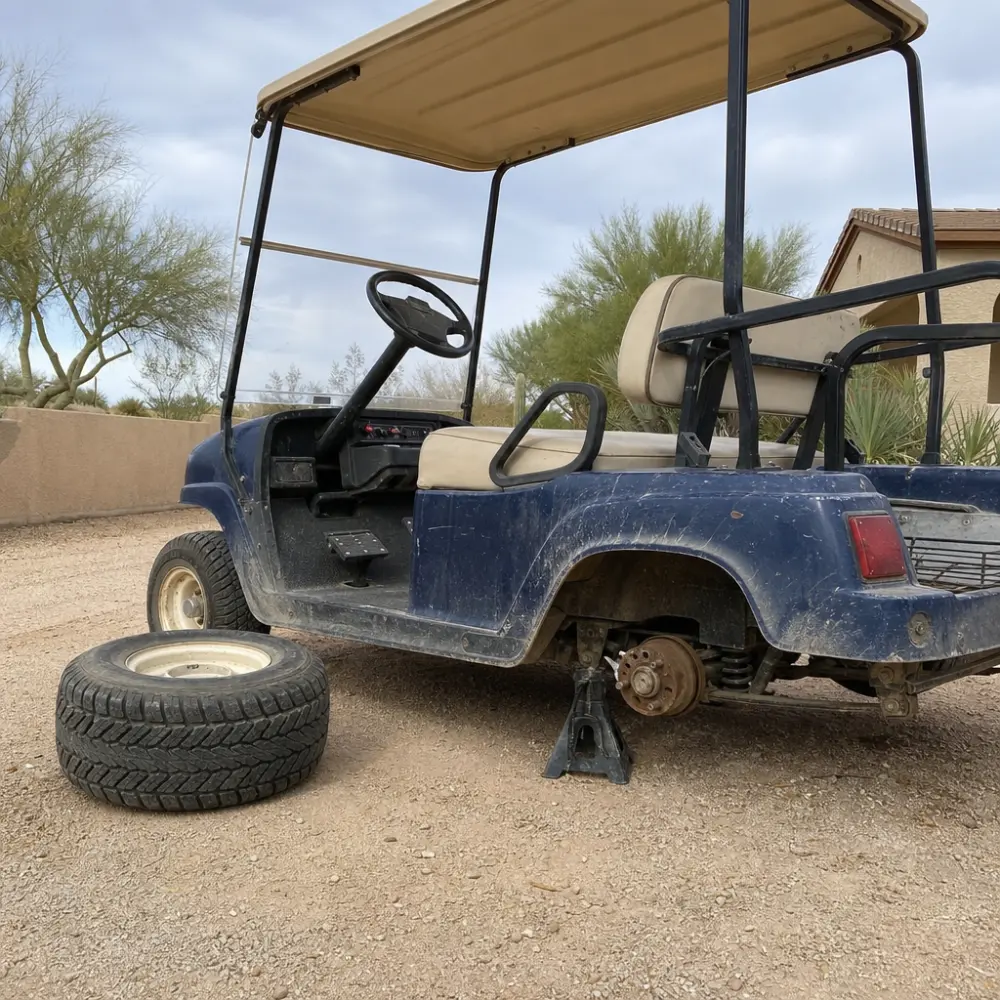
Casa Grande Golf Cart Repair installs full battery packs at your home for $1,200 to $1,800 for lead-acid (36V packs from about $1,200, 48V packs up to roughly $1,800 with premium brands) including terminal service, watering, and haul-away of the old cores. Lithium conversions run $1,600 to $3,500 installed. One visit, batteries already on the truck, anywhere in Casa Grande, Robson Ranch, Eloy, Arizona City, Coolidge, Florence, or Maricopa.
Battery replacement is the biggest-ticket, most predictable expense a cart owner faces. Here is the honest version of everything that matters, including the specific reasons packs in Pinal County die on a schedule.
Why Pinal County packs age the way they do
Lead-acid golf cart batteries last roughly 4 to 6 years under classic golf-course duty. Two things around Casa Grande push a pack toward the short end, hard.
Extreme summer heat. NOAA’s 1991 to 2020 normals for the Casa Grande station put the June average high at 105.8°F and July at 106.8°F, and count 116.8 days a year at 100°F or above, out of 183.8 days a year at 90°F or above. Inside a flooded lead-acid battery, heat does two things. It evaporates water out of the electrolyte faster, and once the level drops below the top of the plates, the exposed lead sulfates and permanently loses capacity. It also raises the self-discharge rate, so a cart that sits in a hot garage for a few weeks in July comes back noticeably lower than it left. A pack that gets watered every two to four weeks through the hottest months and fully recharged after every use will outlast one that does not by a year or more.
Snowbird storage. Casa Grande’s resort communities, Robson Ranch and Palm Creek among them, fill up roughly October through April and empty out for summer. A pack left at partial charge in a closed garage or cart barn through 116.8 days a year of 100°F-plus heat is close to the worst storage condition lead-acid can face. Owners who come back every October to a pack that will not hold a charge are usually looking at exactly this, and it is preventable. The sat all summer page covers the recovery attempt and what it looks like when the pack does not come back.
The symptoms, in the order owners notice them
- Shrinking range. The loop that used to leave half a charge now runs the meter low. The range dropping page walks through the cheaper causes first.
- Longer charging. The charger runs hours past its old finish time, or never quite clicks off.
- Sag at the end of the run. The cart slows on the last stretch home.
- The hard stop. One battery finally quits, and a pack is only as strong as its weakest battery.
Important: these symptoms overlap with charger and cable problems. A failing charger starves a healthy pack and mimics battery death; a corroded main cable, baked by the same heat that ages the batteries, does the same. Before quoting a pack we load-test each battery individually, check specific gravity with a hydrometer on flooded packs, and test the charger’s actual output. If the fix is a $300 charger instead of a $1,200 pack, that is what we will tell you. Sometimes the load test shows one or two failed batteries dragging down four good ones: on a young pack, replacing just those is the right call. On an old pack it is not, since new batteries in series with tired ones get pulled down to the old pack’s level fast, and we will be straight about which situation you are in.
Lead-acid versus AGM versus lithium
| Flooded lead-acid | Sealed AGM | Lithium (LiFePO4) | |
|---|---|---|---|
| Installed cost | $1,200 to $1,800 | Above flooded, below lithium | $1,600 to $3,500 |
| Typical life | 4 to 6 years, less in this heat | Similar, less abuse-tolerant | 7 to 10 or more years |
| Watering | Every 2 to 4 weeks in summer | None | None |
| Heat exposure | Vented, plates and terminals suffer most | Sealed case helps | Sealed, minimal |
| Charging | Overnight | Overnight | A few hours |
| Weight | About 350 pounds or more | Similar | Roughly a third |
| Power at the end of a run | Sags as it discharges | Sags less | Steady until nearly empty |
Flooded is the value default. Trojan T-105s (6V) and T-875s (8V) are the benchmark for a reason, but they demand the watering schedule and terminal care a Pinal County summer punishes you for skipping. AGM buys freedom from watering and a sealed case that tolerates heat cycling a little better, at a premium that makes sense for owners who know they will not maintain flooded batteries. LiFePO4 wins the ten-year math for true daily drivers: one purchase instead of two, zero maintenance, faster turnaround, steady speed to the last mile, and a conversion includes the correct lithium-specific charger, since a lead-acid charger profile will not properly charge lithium.
The deciding variable is usage. A daily driver at Robson Ranch, Palm Creek, or Anthem at Merrill Ranch: lithium usually pencils out. A weekend cart that goes to the course twice a week: quality flooded lead-acid usually wins. We run your actual mileage, not a script. The full comparison is in lead-acid versus lithium for a Casa Grande golf cart, and the battery cost calculator prices any combination.
What the install includes
Every pack replacement gets the same finish: cables inspected and replaced if corroded, terminals cleaned and coated, hold-downs torqued, a full watering on flooded packs, a charger output check, a test drive, and the old cores hauled away for recycling at no charge. All in your driveway or cart barn, with the service call applied toward the job.
A pack being pushed too hard by an overcharging charger or a shorted cell smells like sulfur or rotten eggs before it fails outright; see golf cart battery smells like rotten eggs if that describes your cart, since it needs testing before another charge cycle, not a routine replacement quote.
Know your voltage before you call
The battery count is the voltage giveaway: six 6-volts is a 36V cart, six 8-volts or four 12-volts is a 48V cart. Older Club Car DS and E-Z-GO TXT carts are often 36V; most carts built in the last fifteen years, including ICON and Evolution, are 48V. Higher voltage means a higher pack cost, which is why the range is as wide as it is.
Get a battery quote
Tell us the cart brand and the battery count plus a photo of the battery compartment. You will get a flat installed price, usually with same-day or next-day installation anywhere in Casa Grande, Robson Ranch, Eloy, or Arizona City. And if a load test says your pack has another year in it, you will hear that instead.
Frequently Asked Questions
How much is a full battery pack installed in Casa Grande?
Lead-acid packs run $1,200 to $1,800 installed for most carts: 36V six-battery packs from about $1,200 to $1,600, 48V packs up to about $1,800 with premium brands like Trojan. That includes installation, cable and terminal service, a full watering, and haul-away of the old cores.
How do I know the pack is actually done?
The classic signs: range keeps shrinking, the charger runs longer than it used to, and the cart sags at the end of a run. We confirm with a load test on each battery and a hydrometer reading on flooded packs. Often one or two bad batteries are dragging down the rest, and on a young pack that is all you replace.
How long will a new pack last in Pinal County?
Lead-acid runs roughly 4 to 6 years, and heat pushes it toward the short end: NOAA's Casa Grande station counts 116.8 days a year at 100°F or above. Hot weather evaporates electrolyte and speeds sulfation. Watering every two to four weeks in the hottest months, clean terminals, and full recharges after each use push you toward the long end.
Is lithium worth it here?
For a daily-driver cart at a resort like Robson Ranch or Palm Creek, often yes: 7 to 10 or more years of life, no watering, faster charging, and steady power through the last mile, at $1,600 to $3,500 installed. For a cart that goes out a couple of times a week, quality lead-acid usually wins the math. We run your actual usage honestly.
What happens to my old batteries?
We haul them away, included in the price. Lead-acid cores have real recycling value, so there is no disposal fee and no 60-pound batteries left sitting in your garage.
More golfcart services
Areas we serve
- Casa Grande, AZ
- Mobile Golf Cart Repair at Palm Creek and Casa Grande's RV Resorts
- Mobile Golf Cart Repair at Robson Ranch Arizona
- Mobile Golf Cart Repair in Arizona City
- Mobile Golf Cart Repair in Coolidge
- Mobile Golf Cart Repair in Eloy
- Mobile Golf Cart Repair in Florence and Anthem at Merrill Ranch
- Mobile Golf Cart Repair in Maricopa